Tips for buying the best pair of trainers for running or for longer, urban walks
This blog post:
- Explains how your walking and running gait works
- Describes different trainer types
- Demystifies the trainer-buying process
- Gives tips of what questions to ask yourself when trying and buying trainers for running/longer, urban walks or low-level countryside footpath walking
- For hillwalking: apply the same rules but for most people, opt for a more rigid sole and ankle support
It’s a jungle out there when you think about buying a new pair of trainers. There are so many options, enough to confuse anybody. Many of us don’t buy trainers very often, and when we go to replace our old ones, we find that the model has changed and we have to go through the challenging process of finding a pair that is comfy, doesn’t give us blisters or injuries, and allows us to walk, run, or do whatever activities we enjoy with our feet feeling good.
Here is some advice to help you choose trainers that work for you.
How does our running gait work?
Over the past few decades a multi-million pound sports shoe industry has been built. In the realm of running, there has been a lot of “science” behind developing different types of trainers for different types of running gaits. Now, I am all for choice. But what I am not keen on is pseudo science. There is a lot of trainer company hype about “supination” and, particularly, “overpronation”. Here is a short explanation of our gait, and why these terms, in trainer-buying, can be extremely misleading.
When you run, your heel, or for many of us midfoot, hits the ground first. At this point, your foot lands slightly on the outside of your foot – your foot is now in supination. This is not wrong, it’s normal. Then, you transition through your midfoot towards the toes, moving incrementally into the middle of your foot. As you carry on to what’s called “toe off”, when you push off of that foot, mainly from your big toe, then the foot goes into pronation, meaning that you are a little more on the inside of the foot than the outside. This is also totally normal, it’s not a dysfunction.
So in summary, your heel goes down, you contact the ground with the outside of the foot, your foot travels inwards a bit to the inside of the foot and you push off with your big toe. No need to get too technical. Pronation, the gentle tipping inward of the foot before you push off the ground using your big toe, is totally normal. Please do not worry about pronation.
It is true that many of us tend to pronate quite a lot, especially women due to the angle of our thigh bone (femur) in the hip and also as a result of insufficient usage of the muscles that create our foot arch and due to imbalances in the hip and thigh muscles. So yes, sometimes it can be handy to have a bit of arch support on the inside of the foot. That is fine. As long as if feels comfortable for you.
But, let me repeat PRONATION is totally, 100% NORMAL – it’s part of the natural gait cycle.
I am very glad to have cleared up that old chestnut of the trainer industry who get very over-excited about this term with very little knowledge of what it really means.
I suggest keeping things quite simple and seeking comfort and ease, rather than the perfect, techincal trainer. Trust yourself on what feels right for you, in terms of the flow of your body when you walk or run, and what feels comfortable on your foot, and you are unlikely to go wrong.
Types of trainers
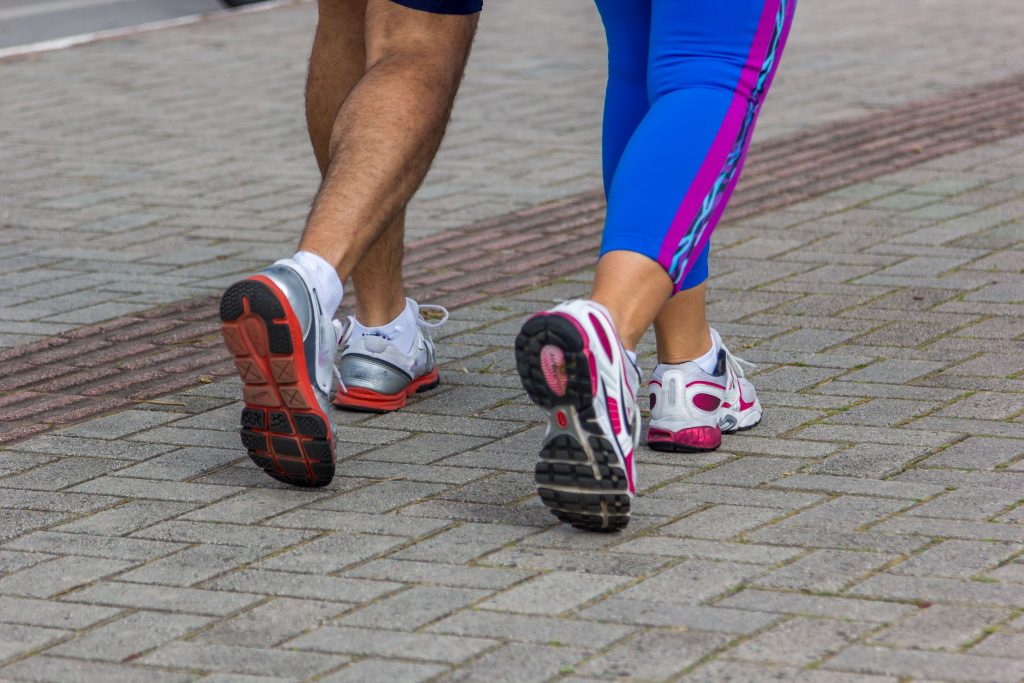
Here is a list of the main types of shoes available for running:
Neutral shoes: for people whose foot goes down pretty evenly, with the usual amount of supination (outside of foot) and pronation (inside of foot).
Support/stability/motion control shoes: for people who feel as if they need a bit more structure in their trainers, so the foot feels quite steady. The trainer companies and running shops will tell you this is for “overprontation” but bear in mind what I said in the gait section – this can be an unhelpful term.
Lightweights/racers/racing flats: a lighter shoe with less cushioning and support, for racing or shorter, more sprightly, pacy runs.
Trail shoes: for off-road running, with extra grip (eg sticky out bits at the side and on the sole) and often a lower heel and less cushioning.
Natural running shoes: tend to be like your classic trainer but more flexible with a lower heel so you feel as if you have some cushioning but still feel a bit closer to the ground than in the classic, chunky-heeled trainer. These are ok if you don’t have any big issues when you run and they can be a good way of feeling as if you’re more “in touch” with the ground whilst still giving you some support and cushioning. (Brooks Pure/Nike Free/Zoot brands). Often they don’t last as long as chunkier trainers so you will probably have to replace them sooner.
Barefoot shoes: have hardly any cushioning and a very low heel, such as Vibram brand shoes. NB most people need to get to this type of shoe in stages. I would not advise moving from a classic trainer to these immediately. You’d need to go via a natural running shoe first. For most people I see, barefoot shoes would be a step too far and tend to cause injury unless people move to them carefully and wear barefoot-style shoes most of the time during the day.
Highly cushioned shoes: These disappeared off the market for a few years, about 15 years ago, when everyone got into barefoot or natural running shoes. They’ve made a reappearance, for example, the Hoka brand. Stick with the principle of finding what feels right for you, whatever the style. I know people that tried the barefoot shoes and didn’t get on with them, and reverted to this type of very cushioned shoe, and vice versa.
NB: If you change the type of shoe that you wear, in a significant way, it’s a good idea to build up your mileage, or time spent in the shoe, slowly until you get used to the new shoe style, to avoid injury or discomfort.
The trainer industry are after your money! Don’t believe the hype!
Don’t believe all the all-singing, all-dancing marketing. No pair of trainers will transform you into Mo Farrah with miraculous gadgetry and no extra training. There is a lot of hype around along the lines of “mimics the natural dynamics of the foot”. The only thing that mimics the natural dynamics of the foot is…the foot!
There is no trainer technology silver bullet. Just keep thinking comfort and ease of movement, and notice how you feel in the shoe when trying it walking round the shop or running round the shop or your house in it if you bought online.
There are good, specialist running shops who give sensible advice. In running shops they are honest and definitely not trying to con you, and they are often experienced walkers/runners, however I have found that they occassionally fall for the hype of the trainer companies, and sometimes do gait analysis with very little training or understanding of how the body works. Their gait analysis will give you a bit of information about how you run but it can also give you misinformation and encourage you to buy uncomfortable trainers because apparently they are perfect for your gait.
If you are quite happy making your own choice, buy a selection of trainers online from a discount retailer such as sportsshoes.com and try them out at home, where you can run back and forth and see how the shoes feel when you turn, plus up and down stairs to see how they would feel on a hill.
Whether you go to a running footwear shop or you buy a selection of discount trainers online then try them on at home, I would suggest doing the following to work out which trainers suit you best.
Top tips for trying trainers
- Seek comfort and ease when you walk or run in your trainers. Don’t believe the trainer company marketing. Question the running shop assistant’s advice. You are the expert on your movement.
- Try on plenty different types of shoes. Take time to find the trainers that make you think “these feel great, I can’t wait to get out in these”.
- Alternatively, if you have trainers that you felt comfortable in for ages, that didn’t give you any injuries and became like an old friend and that you are sorry to see fall apart, get the same ones again, or try something similar if the models have changed.
- Which trainers feel normal when you walk, not just when you run? If they feel awkward when walking, it’ll be worse when you’re running.
- Try your trainers on after exercising, on a hot day or in the afternoon to give a better sense of how your feet will be when you’re running: hot, sweaty and more swollen than first thing in the morning before any exercise.
- Which trainers highlight your known musculoskeletal niggles when you try them out and which don’t? This is much more useful than someone analysing your gait and telling you which trainers to wear. Only you personally can ascertain which trainers feel good when you move. Things to look out for in the trainers you’re trying:
- Do they stop your ankle from moving at the front if they come quite far up the foot? Try a lower cut shoe.
- Do the trainers make you feel as if your knees are caving inwards? Try a more supportive, stability shoe, or one with some arch support, but it must be comfy.
- Do they generally make you feel as if your feet are plodding down like a cart horse, rather than making you feel like a sprightly mountain goat? Try a different style of shoe, this is very personal.
- Do they feel hard and unforgiving, or not cushioned enough? This can happen with support shoes, or natural running shoes with minimal cusioning. Try a more cushioned shoe.
- Do they feel too flimsy and as if you are flopping around in them and don’t have enough structure to support your foot? Try a more supportive, stability shoe.
I hope that this advice helps you to find some comfortable trainers that keep you moving well!